CAMBRIDGE SOCIETY OF KENT

CAMBRIDGE SOCIETY OF KENT
The community of Cambridge University Alumni in Kent, U.K.

WHO WE ARE
The Cambridge Society of Kent arranges meetings for members of Cambridge University residing in Kent to meet and to foster interests they have in common. We are part of a worldwide network of alumni societies of the University and maintain close links with the University Alumni Office.
Membership is open to any former or current member of Cambridge University living in Kent or nearby areas, together with Friends of the University. Membership costs £10.00 a year and members pay for each event that they attend.
WHAT WE DO
The Society organises four meetings a year: two outings over the summer to places of interest in or reasonably near to Kent, and two talks during the winter. There is a convivial lunch at each meeting when members can enjoy a meal together in a relaxed environment.

FUTURE EVENTS
FUTURE EVENTS
ROCHESTER CATHEDRAL
Friday, 17th July at 1.30pm
We shall hold our Summer meeting on Friday 17 July beginning at 1.30pm when we shall be given a guided tour of Rochester Cathedral by John Bailey. This will be followed by tea in the Crypt.
Rochester Cathedral has been a place of Christian worship since 604 AD. It was founded in that year by Bishop Justus on land donated by King AEthelbert of Kent. After the Norman Conquest of 1066 the Cathedral was refounded as a Benedictine monastery and rebuilt on a much grander plan over the next few decades. Two large mediaeval fires and their subsequent rebuilding campaigns have resulted in much of the standing structure we see today.
Our guide, John Bailey, is surveyor of the fabric to Rochester, Wakefield and Guildford Cathedrals as well as Inspecting Architect to many parish churches and is a three times winner of the King of Prussia’s Gold Medal for the repair of historic churches.
AUTUMN MEETING AND AGM
Saturday, 10th October
Our AGM and lecture will be held at Walthamstow Hall on Saturday 10 October 2026 and will be followed by lunch.
CONTACT US
.
Contact the Secretary, David Bonner for more details about these events (email: d-bonner@sky.com) and to book your place.
RECENT EVENTS
CHEVENING HOUSE
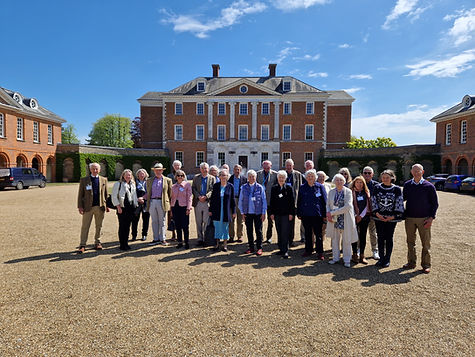
24 members gathered for our Spring meeting on Tuesday 28 April 2026 for a tour of CHEVENING HOUSE and its gardens.
Our guide gave us a fascinating insight into the history of the house and of the Stanhope family. The Grade 1 listed house, built in the early English Palladian style to a design attributed to Inigo Jones, was the home of the Stanhope family from the early 18th century. We admired the portraits of seven generations of the family, from James the first Earl Stanhope, who was successful in several military campaigns in the war of the Spanish Succession and later held high political office under Queen Anne. Later generations of the family served the country not only as soldiers and politicians, but also as scientists and inventors. When the line sadly ran out, the 7th Earl decided in 1959 to give the house to the nation as a grace-and-favour country residence for a senior Cabinet Minister who is, usually, the Foreign Secretary.
Our tour of the house was followed by afternoon tea in the Drawing Room. After tea, many members explored the garden and grounds surrounding the house.
LAVENDER FIELDS FOREVER
27 members enjoyed a visit to Castle Farm, Shoreham, on 8 July 2025. Castle Farm is near Sevenoaks, in the delightful Darenth Valley, where the Alexander family have farmed since 1892. Its famous fields of lavender, which attract thousands of visitors every year, were in their full flowering glory in early July when we visited.
The setting was beautiful and the weather perfect. Caroline Alexander (Girton ’69) and her husband William talked about the history of the farm and its diversification enterprises, including an ambitious plan to improve the ecology of the River Darenth. They talked about the growing and harvesting of lavender as well as the identification of different varieties by appearance and fragrance and the functional uses of the oils.
Following the talk and a tasting of the farm’s apple juice and lavender biscuits, there was an opportunity to enjoy a brief ‘behind the scenes’ walk through the heart of the farm to see the farm’s oil distillery.


STAINED GLASS IN KENT
It is an art form which has developed in Kent over 850 years: it features dazzling colours, a variety of subject matter and is available for everyone to enjoy. This is stained glass. Paul Britton told the story of Kent’s stained glass to more than 50 members of the Society at the meeting on 15th February 2025, drawing on illustrations from more than 100 examples of stained glass from all over the county.
Kent churches are rich in stained and painted glass. Canterbury Cathedral has one of the best collections of early medieval glass in Europe and the county's parish churches contain outstanding examples of glass of every age, especially the 19th and 20th centuries. The artists creating stained glass in the early mediaeval period demonstrated considerable artistic skill, backed up by sophisticated technical knowledge, to produce images in a range of deep colours. There is still a rich legacy of mediaeval glass in churches throughout Kent. The creation of stained glass was brought to an end in the Reformation. In the 1830s, after a gap of some 300 years, artists became fascinated by the art of the middle ages and revived the old techniques of making stained glass. It became highly fashionable. Pugin used stained glass in his house in Ramsgate, Burne Jones and William Morris were among many leading artists who designed windows for churches around the county. The tradition continued into the 20th century – including the well known set of windows created by Marc Chagall for Tudeley Church. The last of the firms making stained glass windows closed in 2011 but there are still many artists today working in stained glass.

WINE TASTING AND VINEYARD TOUR AT YOTES COURT

ROYAL COLLEGE OF MUSIC
30 members of the Society visited the Royal College of Music on Wednesday 18th February 2026. Members inspected the rich collections in the college’s museum, including the earliest stringed keyboard instrument, examples of a spinet, clavichord and other keyboard instruments; richly decorated stringed instruments; and a series of clarinets showing how the clarinet developed into the modern instrument used today . The museum also has some of the College’s portraits of musicians, including one of the the most recognised portraits of Joseph Haydn.
We also attended a rehearsal of the RCM Philharmonic, led by acclaimed conductor Anna-Maria Helsing in the Concert Hall: members listened to the players being coached for a performance on the following day of the Ravel G Major Piano Concerto and Brahms’ Third Symphony.
Members then attended a private recital by two gifted young singers and an accompanist. We heard duets from Mozart’s Don Giovanni and the meeting of Papageno and Papagena from the Magic Flute, among a number of other opera arias, and the recital ended with a rousing performance of Irving Berlin’s “Anything you can do, I can do better”
The visit ended with lunch in the College’s refectory where we had the opportunity to chat to some of the students.
OBSERVING THE WORLD OF POLITICS
Sir Peter Riddell PC was our guest speaker after the AGM on 18 October, 2025. In a career as an economics and political journalist on the Financial Times and The Times from 1970 until 2010 he had observed leading politicians from Wilson to Blair and Brown at close quarters and his talk on life as a political voyeur was full of interesting and amusing anecdotes and reflections He spoke warmly of the leadership qualities of Mrs Thatcher and Tony Blair, but found it difficult to identify similar qualities among recent political leaders. In his own career, and in politics, he suggested that the role of luck should not be underestimated. In his case this had led to a career after journalism that included spells as Commissioner for Public Appointments and Director of the Institute of Government as well as an unexpected elevation to the Privy Council. Members gave a warm thank you to a fellow Alumnus before joining him for an excellent lunch.
SOMETHING’S BREWING
Members travelled to Faversham on 22 May 2025 for a meeting at the Shepherd Neame Brewery, Britain’s oldest brewer with an official founding date of 1698, though there is evidence of brewing here well before that date.
We were taken on a tour through the old buildings of the Brewery, up stairs, winding through vats and finally to their tasting room. We followed step by step the brewing process, how malt, yeast, hops and water are combined in different ways to create a variety of different beers. We visited the Old Brewery Store, which features impressive displays of historic delivery vehicles, a recreated coopers’ workshop, bygone pub signs and a collection of hop picking memorabilia. At the end of our tour we tasted six beers in contrasting styles and our guide explained how each one had been developed to meet changing tastes and fashions in beer drinking.
Our meeting ended with a short walk down Faversham’s pretty High Street for a delicious lunch at the Sun Inn.


A TOUR OF LEEDS CASTLE
On May 21st, 2024, the society visited Leeds Castle, a magnificent monument to the history of England since 857. After over a thousand years of change and re-structuring, for most of the 20th century it was privately owned by Lady Baillie, daughter of Almeric Paget, 1st Baron Queensborough and Paula Payne Whitney, an American heiress. On her death in 1975 she left it to The Leeds Castle Foundation, which owns it still.
As we toured the interior, we were struck by the clear sense of its having been a family home for many decades, but that the family had treasured its centuries of royal history, and sought to maintain that sense of majesty. Beautiful both inside and out, the castle now hosts many public functions and boasts extensive gardens, a lake with a ferry as well as the traditional moat, a falconry area, golf course, themed playgrounds, a maze and opportunities to stay in one of the cottages onsite.
Unfortunately the weather discouraged us from spending time in the parkland and gardens as it poured relentlessly all day. However, with wonderful Cambridge fortitude, we smiled our way to warmth and conviviality - especially in the large, comfortable restaurant where we were able to relax and enjoy each other’s company during lunch.
Despite the rain, it was another thoroughly successful visit, and our thanks go to Althea Chapman whose attention to every member’s needs and ability to rise above minor details like umbrellas and wet guests, ensured its smooth-running and excellent organisation.
THE CINQUE PORTS
Standing high on the Greensand Ridge, members looked down on immaculate rows of vines, sweeping down the hill towards Yotes Court, an historic Grade 1 listed manor house, and the picturesque village of West Peckham. The lower slopes are planted with the classic Champagne vine varieties, producing grapes to make into classic English sparkling wine. Higher up are various different varieties, including Bacchus and a new red variety, Divico, which was developed in Switzerland. These vines are used to make the wines sold under the Yotes Court label.
We heard how the vineyard was planted in 2016 on a beautiful south facing slope where the free-draining soil is perfect for growing grapes and how the vines are managed as far as possible in a sustainable manner with minimal use of sprays.
After our tour of the visit we went to the vineyard’s tasting room, where we were introduced to a selection of the wines made from the Yotes Court vines in a tutored tasting, while enjoying a delicious lunch and stimulating conversation.
The day started with a visit to the fascinating Palladian Church at Mereworth, where our guide was the Rev. Canon Brian Stevenson.
Some 30 members and Friends of the Society attended the Society’s AGM on 26th October 2024 and heard reports on the Society’s activities over the last year and the plans for the future.
After the formal meeting, Philip Lewis gave a talk on the history of The Cinque Ports. Philip is a former mayor of the small town of Fordwich, which lies on the River Stour, just down river from Canterbury. During the Middle Ages Fordwich served as the port for Canterbury, and goods flowed through the town from the Continent, using a navigable channel to the west of the Isle of Thanet.
Five ports and two ancient towns - The Cinque Ports - formed a confederation, gaining privileges and rights in return for 'Sea Service', providing ships for the defence of the realm. Men from these ports lived also from fishing, trading, piracy and smuggling. In the modern era, the Cinque Ports are no longer responsible for defence but the Confederation still exists and celebrates its rich history.

OUR COMMITTEE
The Society is run by a Committee.
The current members are:
Brian Stevenson (President)
Miriam Westendarp (Chairman)
Margot Croft (Vice Chairman)
Alec Crowe (Membership Secretary)
Althea Chapman (Events Secretary)
David Bonner (Secretary)
Nick Ward (Treasurer)
Felicity Crowe
CONTACT US
If you would like to know more about the Society, or would like to join, email the Secretary, David Bonner, d-bonner@sky.com

